
This guide uses AI-assisted desk research and drafting, not hands-on testing or professional installation advice. Read our editorial standards or send a correction.
The spray used to feel even. Now it's thinner, or it fires slightly off to one side, or it seems to splutter for the first second.
There's no warning light. The remote looks happy. You haven't changed any settings.
If you live somewhere with hard water, limescale is one possible cause. On models with a water hardness setting, it's also worth checking that the reminder was configured for your supply. Neither the spray pattern nor the absence of a warning confirms the cause on its own.
Quick answer: Check your model's manual for surface cleaning, nozzle care and descaling. Geberit's AquaClean Sela guide recommends daily removal of water drops, weekly nozzle checks and descaling at least once a year. Its reminder also depends on the water hardness configured at installation, so compare that setting with your water supplier's figure. Other models may need a different routine.
Here are the questions I'd expect you to be asking. Each one gets a proper answer further down:
- Why does the spray get weaker even when the descale light never comes on?
- How hard is my water, really, and why does the number on my water company's site not match anything in my manual?
- Can I just use vinegar or a kettle descaler?
- Will a water softener sort this out for good?
- How often is "regularly" when the manual won't give a number?
The descale light isn't a limescale sensor
Most advice about bidet seat limescale stops at "descale when the light tells you to". It sounds sensible. The seat knows best.
Here's the thing most people never find out. On at least some seats, the light isn't measuring scale at all.
Geberit's housekeeper and cleaning guide for the AquaClean Sela says it plainly: "During installation, the device was configured for the local water hardness". That setting exists, the guide explains, to prevent unnecessary descaling.
So the reminder is an estimate. It's worked out from a hardness band somebody chose on fitting day.
If that band was right, the reminder should arrive at sensible intervals. If the installer left it on a default, guessed, or set it for a softer area than yours, the reminder can arrive after the scale has already started to build.
That's my inference from how Geberit describes the setting. Geberit doesn't publish how the interval is calculated. But the logic is hard to argue with: a reminder designed to avoid unnecessary descaling in soft water will, by design, wait longer.
Which is why the first job isn't buying descaler. It's finding out what your water actually is.
How hard is UK tap water, and why is the number so confusing?
The Drinking Water Inspectorate classifies hardness by milligrams of calcium carbonate per litre (mg/l CaCO3):
| DWI band | mg/l as calcium carbonate |
|---|---|
| Soft | up to 100 |
| Slightly hard | 100 to 150 |
| Moderately hard | 150 to 200 |
| Hard | 200 to 300 |
| Very hard | more than 300 |
The DWI says hard water "causes scaling in hot water systems, kettles, electric irons and domestic appliances". A bidet seat that heats water is a small domestic appliance with very fine spray holes. It's on that list in all but name.
Where you live matters a lot. Anglian Water says all the water it supplies is classed as hard to very hard. Thames Water says its water is hard because it passes through chalk and limestone. The DWI also warns that there's local variation, so it recommends asking your water company for the exact figure rather than reading it off a national map.
Now for the confusing part.
Your water company will probably give you mg/l, and sometimes Clark degrees. The Geberit guide I mentioned gives its bands in three other units: French degrees (°fH), German degrees (°dH) and English degrees (°eH). Three units, none of them mg/l.
It's very easy for an installer, or you, to look at a number in one unit and pick the band in another.
Convert your number before you compare it
These are the standard conversions, all based on mg/l of calcium carbonate:
| Unit | Equals roughly |
|---|---|
| 1 French degree (°fH) | 10 mg/l |
| 1 English or Clark degree (°eH) | 14.3 mg/l |
| 1 German degree (°dH) | 17.8 mg/l |
The Clark figure comes from its old definition: one grain of calcium carbonate per imperial gallon. A grain is about 64.8 mg and an imperial gallon is about 4.546 litres, so one Clark degree works out at roughly 14.3 mg/l. You can check that on a calculator yourself.
And here is the Geberit Sela table converted into mg/l, so you can line it up against your water company's figure:
| Geberit band | Geberit's figures | Roughly in mg/l |
|---|---|---|
| Soft | up to 15 °fH, 8 °dH, 11 °eH | up to about 150 |
| Medium | 15 to 25 °fH, 8 to 14 °dH, 11 to 18 °eH | about 150 to 250 |
| Hard | over 25 °fH, 14 °dH, 18 °eH | over about 250 |
Notice something. Geberit's "soft" band reaches up to about 150 mg/l, which the DWI would call slightly hard. And a home at 260 mg/l sits in Geberit's top band, while a home at 240 mg/l does not.
So a seat in a London flat and a seat in a Lincolnshire farmhouse might both be on "medium", even though their water behaves very differently. That's not a fault in the table. It's a reason to know your own number.
Scale collects in three places, and each one needs a different fix
This is the distinction that makes most limescale problems easy to diagnose.
Think about three places where scale can collect. Your model's manual determines which parts its descaling programme treats and which need separate cleaning.
1. Inside the seat. The water heater, valves and internal pipework. This is what the built-in descaling programme is for. You pour in descaler, the seat circulates it, then flushes it out. You can't reach these parts yourself, and you shouldn't try.
2. At the nozzle. The spray holes are tiny. When water is left on the nozzle tip after use and evaporates, the minerals stay behind. A few specks of scale across the holes are enough to narrow the spray or bend it to one side.
3. On the outside. The seat, lid, housing and ceramic. Drips dry into white marks. These are mostly cosmetic, but they're also where people reach for the strong cleaners that do real damage.
Now you can answer the first question from the top of this page.
When the spray gets weaker and the descale light hasn't come on, the nozzle is one place to check, rather than a confirmed diagnosis. Geberit's Sela guide lists nozzle cleaning separately from the device's descaling programme. Check your own manual for nozzle and inlet-strainer maintenance rather than assuming the reminder covers those jobs.
So a descaling cycle alone may not resolve every nozzle or spray problem.
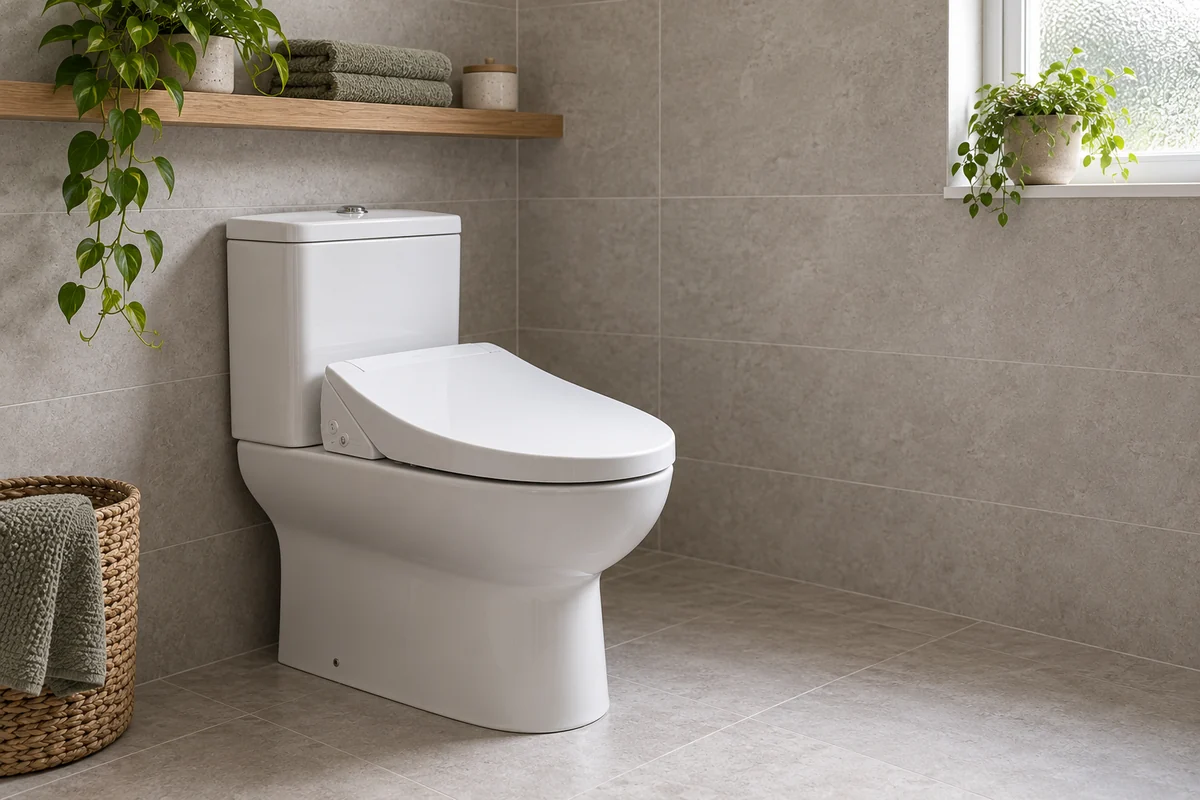
AI-generated illustrative bathroom scene, not a product test or an installation example.
Find your water number in ten minutes
You can do this today, and it costs nothing.
- Find your water supplier. It's on your water bill. If you rent and don't get the bill, your landlord or letting agent can tell you, or you can search your postcode on your local supplier's site.
- Look for a water quality or hardness checker on the supplier's website. Most ask for a postcode.
- Write down the hardness figure and its unit exactly as shown. If it gives several, note the mg/l figure as calcium carbonate.
- Convert it into the unit your seat's manual uses, using the table above.
- Write the result on a sticky label and put it inside the cupboard where you keep the bidet seat paperwork. You'll need it again when you change supplier settings, sell the house or call for a repair.
If your supplier gives only a description, such as "hard", ask them for the number. A description won't tell you which side of a band boundary you're on.
Check what your seat was set to
This step is the one almost nobody does.
If your seat has a water hardness setting, find out what it is. Depending on the model, it might be in the seat's menu, in the manufacturer's app, or only accessible to the installer or service engineer.
Geberit's own material says functions and settings in its Home App vary between devices, so I can't tell you where the option sits on every model. What you can do is:
- Look in your manual's index for "water hardness".
- If you can see the setting, compare it with your converted number.
- If you can't see it, ask the installer who fitted the seat what hardness they set. Many will have a commissioning sheet.
- If the installer can't help, contact the manufacturer's UK customer service with your model and serial number and ask how to check and change it.
For TOTO WASHLETs, I couldn't find a published water hardness setting. TOTO says on its blog that every WASHLET has an automatic descaling mode that prompts you when descaling is due. It doesn't explain how that prompt is timed. If you own a TOTO and live in a hard water area, check your model's manual or ask TOTO about the appropriate interval rather than borrowing the Sela's annual schedule.
Keep a diary date even if the light stays off
Geberit's Sela guide gives the one firm figure I could find from any manufacturer: regular descaling "at least once a year".
For a Sela, the guide supports this routine. For other models, use their own maintenance instructions and intervals:
| How often | What to do | Which scale it deals with |
|---|---|---|
| After use, or daily | Wipe water drops off the seat and housing with a soft, lint-free cloth | Outside |
| Weekly | Extend the nozzle, look at the holes, rinse it under running water | Nozzle |
| When prompted, and at least yearly | Run the built-in descaling programme with the right product | Inside |
| When the spray looks wrong | Clean or soak the nozzle as your manual allows, and check the inlet strainer | Nozzle and inlet |
The daily wipe comes straight from Geberit, which lists removing water drops with a soft cloth "to avoid limescale stains". The weekly nozzle check is also in Geberit's guide: test the spray nozzle, clean it if needed, and rinse it under running water.
If your retrofit seat has no descaling programme, follow its manual for the maintenance it does require; don't assume nozzle and inlet cleaning are the whole job. Consumer Reports suggests cleaning the nozzle by hand about once a month even when the seat has a self-cleaning nozzle feature, and notes that some seats have a strainer near the water inlet to keep minerals and debris out.
Run the descaling programme without wasting a bottle
When the prompt comes, or the maintenance date specified for your model arrives, here's how the process typically works. The annual requirement above is from the Sela guide, not a universal interval. Always follow your own model's manual, because the steps differ.
- Buy the descaler before you need it. If the seat locks its spray function, you don't want to wait for a delivery.
- Pick a time when nobody needs the spray for an hour. Geberit's Sela guide says its programme lasts up to 40 minutes. Geberit's Mera Comfort page says not to use the shower toilet for around 60 minutes. TOTO says its process takes about an hour, and you can still use the WASHLET as an ordinary toilet in the meantime.
- Make sure the nozzle is fully retracted and the lid is closed, if your manual asks for that.
- Open the filling point. On the Sela it's under a design cover, with a plug.
- Start the descaling menu first, then wait for the seat to say it's ready before pouring. The Sela shows a "Fill in the descaling agent" message.
- Pour in the full amount. For the Sela that's one 125 ml bottle of Geberit AquaClean descaling agent.
- Wipe up any splashes straight away with a damp cloth.
- Start the programme and let it finish.
One warning from Geberit is worth knowing before you start. Once you've poured in the descaler, don't cancel the programme. The guide says it would "be flushed away unused".
What happens if you keep ignoring the reminder
Geberit's guide lists a second state, "Descale device now, device locked", which appears after "multiple rejected descaling requests". At that point it says a shower procedure is no longer possible without descaling.
So the seat still works as a toilet, but the wash function stops. If your spray has suddenly vanished and the light is flashing blue and red, that's probably what has happened. Descaling should bring it back.
The descaler question: vinegar, kettle descaler or the brand's own?
This is where generic cleaning advice gets people into trouble.
Lots of websites tell you to soak a bidet nozzle in vinegar. For a cheap seat, with a nozzle that comes off, the manual may well allow that. For a premium seat's descaling programme, it's a different matter.
The two big brands say different things:
- Geberit is unambiguous. The Sela guide warns that "Inappropriate descaling agents can damage the device" and says to use only Geberit AquaClean descaling agent.
- TOTO is more relaxed. Its blog says you don't need special descaling products from the manufacturer and can buy the products it recommends from a local chemist.
Those positions aren't contradictory. They're different products with different internal materials. But they do mean there's no universal answer, and that the one-size advice online can't be trusted for your seat.
My rule is simple. For anything that goes inside the seat, use exactly what your manual names. If you can't find the manual, download it from the manufacturer's site using the model code on the seat's label before you buy anything.
For the outside, Geberit lists what's suitable: skin-friendly, low-foaming, liquid, water-dilutable cleaners, with low acid content permitted, "e.g. heavily diluted citric acid". It also warns that aggressive and scouring cleaners can damage the surface. That's a useful general guide for any plastic seat, but check your own manual too.
Fix a weak or wonky spray, in order
If the spray has changed, these are possible checks, not a diagnosis or a ranking of fault frequency. Follow your model's manual and only carry out maintenance it permits owners to do.
- Look at the nozzle. Extend it using your remote or the manual's cleaning mode. On the Geberit Sela, you press the shower and plus buttons together. Look closely at the spray holes in good light. White or grey specks over the holes are your answer.
- Rinse and wipe the nozzle. Use running water and a soft cloth, as the manual describes.
- Clean or soak the nozzle only as your manual allows. The Sela's spray nozzle pulls out for "cleaning and descaling". TOTO says its spray nozzle can be removed from the wand for manual descaling. Other seats may not have a removable tip at all.
- Replace the nozzle if it won't come clean. Geberit's guide says to replace the spray nozzle "if it can no longer be completely cleaned and descaled". A replacement nozzle costs far less than a call-out.
- Check what your manual says about the inlet strainer or filter. Some seats have a mesh strainer where the hose meets the seat. Only inspect or clean it yourself if your model's manual permits this and explains how to isolate the water safely; otherwise ask the manufacturer's service team or a qualified plumber. Don't confuse it with an odour filter: Geberit's Mera Comfort troubleshooting guide identifies the ceramic honeycomb filter as part of odour neutralisation, not water-inlet maintenance.
- Run the descaling programme. If the nozzle and strainer are clean and the spray is still weak, the scale may be inside.
- Check your water pressure. If every tap in the house has gone weak too, the problem isn't the seat.
- Call the manufacturer. If none of that works, stop there. Don't open the seat.
If the spray has been weak since the day it was fitted, don't assume limescale is the cause. Ask the installer or manufacturer to check pressure and installation requirements, which our Japanese toilets guide covers.
Will a water softener solve it for good?
Possibly. But only if the softened water actually reaches the seat.
The Drinking Water Inspectorate says you should not soften the water to the kitchen tap you use for drinking and cooking. So many softened homes have at least one unsoftened branch. Depending on how your plumbing was laid out, the toilet's cold feed may be on the softened side or the unsoftened side.
Before you spend money on a softener for the sake of the bidet seat:
- Ask your plumber which supply feeds the toilet's cold water.
- If it's unsoftened, ask whether moving it to softened water is practical and permitted for your installation.
- Check your bidet seat's manual for anything it says about softened water.
The DWI also notes that softened water contains more sodium and may be more aggressive to some plumbing, and recommends using a reputable supplier and a qualified plumber. Those are reasons to treat a softener as a whole-house decision, not a bidet seat accessory.
Mistakes that turn a cleaning job into a repair
These are the ones I'd avoid.
- Using a strong limescale remover on the plastic seat. Bathroom scale sprays are designed for ceramic and chrome. Geberit specifically warns against aggressive and scouring cleaners on its surfaces.
- Putting the wrong descaler into the programme. Especially on a Geberit, where the manual names a single product.
- Cancelling a descale halfway. You lose the descaler and the scale stays put.
- Ignoring the prompt for months. On a Geberit, repeated refusals can lock the spray function.
- Scraping the nozzle holes with a pin. It's tempting. It can enlarge or scratch the holes and permanently change the spray pattern. Rinse, soak as allowed, or replace.
- Opening the seat to "get at the scale". Inside are mains-powered heating parts and water. Leave internal repairs to the manufacturer's service team, and protect your warranty.
On the warranty point, this is also why it's worth asking about spare nozzles and filters before you buy a seat. Our buying guide's support section lists the questions to ask the retailer.
When limescale isn't really your problem
It's worth knowing when to stop blaming hard water.
If you live in a soft water area, under about 100 mg/l on the DWI scale, don't assume a sudden spray change is limescale. Debris in the strainer or a fault are other possibilities to discuss with the manufacturer.
Cold water, beeping or an error message do not identify the cause on their own. Geberit's Mera Comfort troubleshooting guide lists descaling as a remedy when the shower water no longer reaches its usual temperature, so reduced warmth does not rule scale out. Geberit's Sela guide uses a flashing red light for a pending fault and tells you to contact customer service. Follow your model's fault guidance and contact the manufacturer rather than opening the device.
And if you're still choosing a seat and you live in a hard water area, this is a good moment to change the questions you ask. Ask how the descaling reminder is timed, whether there's a hardness setting, which descaler it needs, and whether the nozzle tip can be replaced at home. Those answers will matter far more in year three than a dryer setting. Our guide to the best bidet seats for UK toilets and our TOTO WASHLET guide cover the models sold here.
So, back to the opening questions.
Weak spray without a warning can have several causes, including scale or debris at the nozzle or inlet; the warning light alone doesn't identify the fault. Your water company's number may not match your manual because they use different units, and the conversion table above helps you compare them. Vinegar is fine only where your manual says so, and never in a Geberit's descaling programme. A softener helps only if the seat is on softened water. For the Geberit Sela, the guide specifies descaling at least once a year. For any other model, follow its own instructions and prompts rather than assuming that interval applies.
Common questions
How often should I descale a bidet seat in a hard water area?
Follow your model's manual and descale prompt. Geberit's AquaClean Sela guide says regular descaling is needed at least once a year, and that the reminder depends on the water hardness set when the device was installed. For a Sela, keep that annual requirement in your diary. For other models, check the manufacturer's recommended interval rather than assuming the same schedule applies.
Can I use vinegar to descale my bidet seat?
Not for the built-in descaling programme unless your manual says so. Geberit tells owners to use only Geberit AquaClean descaling agent because inappropriate descalers can damage the device. TOTO says to use the descaling products it recommends. Check your model's manual before putting anything into the seat.
Why is my bidet seat spray weak when the descale light hasn't come on?
Scale or debris at the nozzle tip or inlet strainer is one possible cause, but weak spray alone does not confirm it. Follow your model's manual to inspect and clean accessible parts, and check whether it specifies separate nozzle or filter maintenance. If that doesn't help, contact the manufacturer.
How do I find out how hard my water is?
Use your water supplier's postcode checker or water quality report. The Drinking Water Inspectorate says your water company is the best source because hardness varies locally. Write the figure down in mg/l as calcium carbonate, then convert it to the unit your seat's manual uses.
Will a water softener stop limescale in my bidet seat?
It can only help if the seat's cold feed is actually on softened water. The Drinking Water Inspectorate says the kitchen drinking tap should not be softened, but that doesn't tell you which supply feeds the toilet. Ask your plumber before assuming a softener protects the seat.