
This guide uses AI-assisted desk research and drafting, not hands-on testing or professional installation advice. Read our editorial standards or send a correction.
This overview explains Japanese toilet terminology, product types and the UK fit, power and water questions. Already shortlisting a purchase? Use our pre-purchase fit checklist to collect measurements and seller answers.
You've used one in a hotel in Tokyo, or at a friend's new en suite, and now you're standing in your own bathroom looking at a perfectly ordinary white toilet. You're wondering whether it can become that.
Then the doubts start. Will it fit the toilet you've got? Is there even anywhere to plug it in? What will it really cost once someone has fitted it? If it breaks in three years, who in the UK fixes it? And is a spray of water next to a toilet allowed by the plumbing rules here?
Those are the right questions. I'll answer every one of them below, in the order that saves you money.
Quick answer: A Japanese toilet in the UK means either an electric bidet seat fitted to your existing pan, or a full shower toilet, usually wall-hung on a concealed frame. Both need mains power beside the toilet and a cold feed with backflow protection. Seats suit a working bathroom; full toilets suit a refit where the wall is open.
Most people start with the product and work backwards
The usual route goes like this. You search, find a model with good reviews and a heated seat, and add it to the basket. Then you ask the plumber to fit it.
That's when the problems arrive. There's no power point. The seat overhangs the front of the bowl. The plumber wants to know about backflow protection, and the listing doesn't say. Or the toilet you fell for is wall-hung and your bathroom has a floor-standing pan against a finished, tiled wall.
These are installation and fit questions to settle before choosing a product.
The reverse order works better. Survey your bathroom first, then shortlist only products that suit it. It sounds obvious. This keeps the shortlist tied to the work your room actually needs.
Seat or full toilet: fit, services and planned building work
Most guides treat this as a money question: seats are cheaper, full toilets are nicer, so pick by budget. Prices do overlap, though. A good bidet seat can cost more than an entry-level shower toilet.
The choice depends on pan compatibility, water and power, available space and the building work you are willing to undertake. Wall access matters for concealed-frame models, but it is not the only deciding factor.
There are three types of product sold in the UK:
| Type | What it is | What it needs | Best suited to |
|---|---|---|---|
| Non-electric attachment | Thin plate between pan and seat, cold-water spray only | A cold feed | Trying the idea cheaply; no heating, no dryer |
| Electric bidet seat | Replaces your seat; heats wash water, retractable nozzle, usually heated seat, sometimes dryer, deodoriser and remote | Cold feed via a T-valve, mains power beside the toilet, a pan it fits | Keeping your current toilet and finished walls |
| All-in-one shower toilet | Wash built into the toilet itself | In the UK usually wall-hung, with cistern, water and power hidden in a concealed frame | A bathroom refit where the wall will be open anyway |
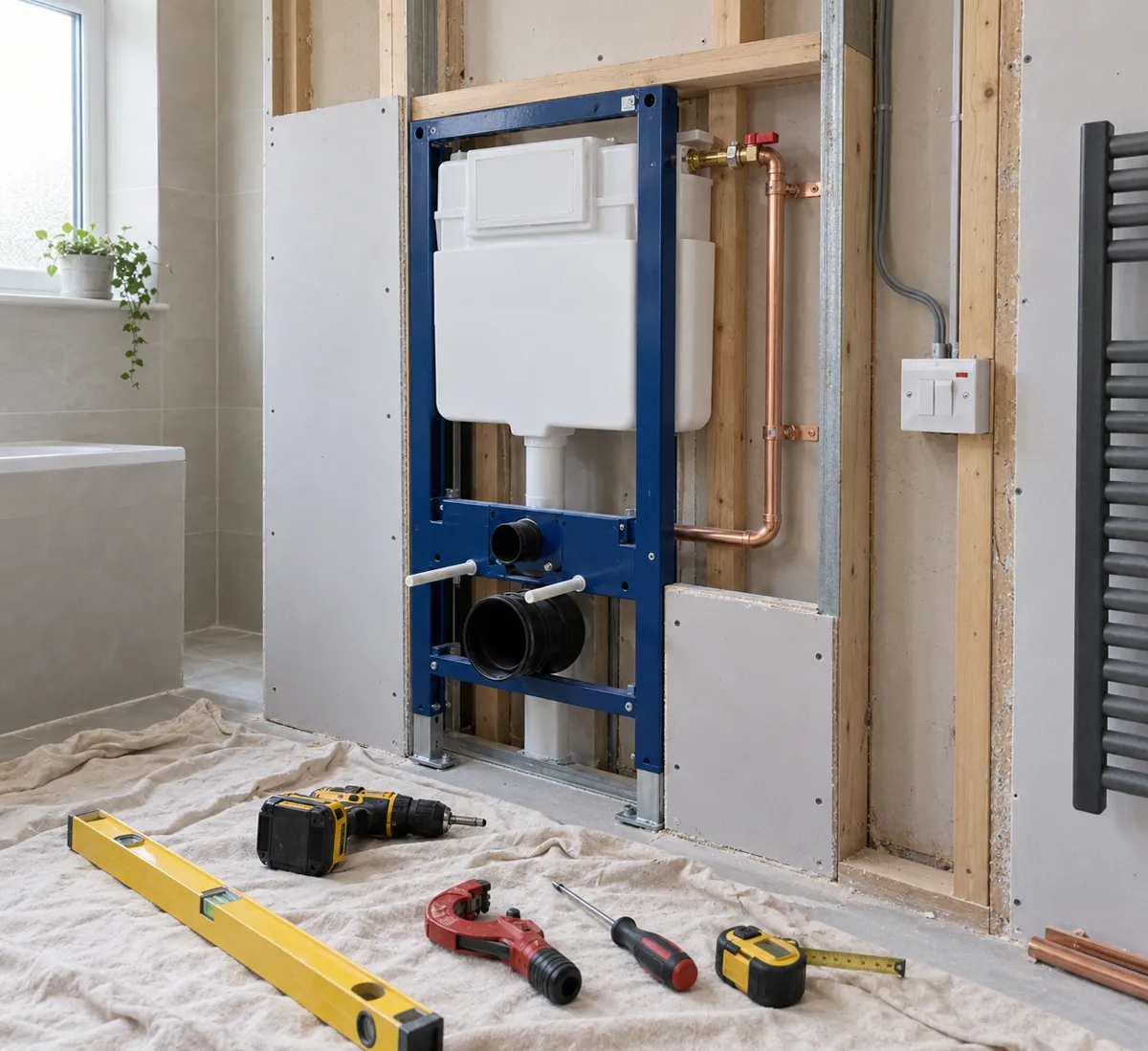
A concealed frame can make a wall-hung shower toilet easier to plan during a refit, but an installer may also be able to use an existing suitable frame or new boxing-in. The cistern, water supply and power connection all sit behind a false wall or boxing. If your walls are coming down anyway, adding those connections is part of a job that's already happening.
If your bathroom is finished, fitting a wall-hung shower toilet may involve a new frame, boxing-in, tiling and power. Check what can be reused before assuming a full renovation is necessary. A seat, by contrast, sits on the pan you already have.
A planned refit is useful context, not a rule that fixes the product type. Ask an installer to assess the exact model and existing services.
Every Japanese toilet in the UK needs three things your bathroom may not have
Strip away the features and every electric seat or shower toilet asks your bathroom for the same three things:
- Mains power right beside the toilet.
- A cold water feed, with protection that stops dirty water getting back into the drinking supply.
- A physical fit: either a pan the seat matches, or a wall that can take a concealed frame.
Each one has its own trade (electrician, plumber, or the retailer's fit check). Each one is also where your budget leaks if you find out too late.
The next three sections take them one at a time.
Budget for the power connection separately
Do not assume there is a suitable power connection next to the toilet. Wiring rules keep ordinary sockets away from baths and showers.
So "comes with a UK plug" on a listing doesn't mean you can plug it in. It means the product is ready for a power connection that you probably don't have yet.
The usual solution is a fixed connection, such as a fused spur, fitted by an electrician near the toilet. Where that ends up depends on the product and on what the installation instructions show, so have the instructions to hand when you ask for a quote.
Part P applies in England and Wales, but their notification requirements are not identical. Ask your electrician which work needs notification in your location and who will handle it. See the Welsh Government guidance and Approved Document P for England. Scotland and Northern Ireland have different rules.
I can't give you a price for this part. It depends entirely on where your nearest suitable circuit is and how hard it is to get a cable to the toilet. That's why it needs a quote. It's also why you should get that quote before you buy anything.
Never run an extension lead into a bathroom to power a seat, not even "just for now".
Water is the connection with rules attached
The water side looks simple. A bidet seat usually connects to the cold pipe feeding your cistern, using a T-piece that comes in the box.
The rules are less simple. Under UK water regulations, a spray used for washing next to a toilet is fluid category 5, which is the highest risk category. In plain terms, dirty water must never be able to flow back into the drinking supply.
Some products have suitable protection built in, often an internal air gap. Others need extra protection added in the plumbing. The listing often won't tell you which, so ask the seller to confirm it in writing and show that answer to your plumber.
Water Regs UK says bidet showers or douches adjacent to toilets are notifiable in Scotland and Northern Ireland and could be notifiable in England and Wales. Approved-contractor exceptions may apply. Ask your water supplier or an approved contractor about your exact product and installation before work starts.
Then there's pressure. If your house is older and fed from a cold tank in the loft, your pressure may be low, and a very low pressure can give a weak, disappointing wash. Every product states a pressure range in its documentation. Your plumber can tell you whether your supply sits inside it.
"Fits most UK toilets" can be true and still not include yours
This is a fit check to make before buying a seat.
Many electric bidet seats are designed around elongated pans. A lot of UK toilets are round and shorter. So a seat really can fit most toilets sold in the UK and still hang over the front of yours, or sit with its control unit fouling the cistern.
You can see this in the published dimensions. Two seats on the site's shortlist:
- The VOVO VB-6100SR is a round-pan seat, with fixing-hole spacing of 135 to 200 mm and a fixing-to-front distance of 410 to 440 mm.
- The TokyoSeat Classic (L-MSC406L UK model) is an oval seat measuring 510 x 455 mm, with fixing spacing of 115 to 185 mm.
Those are different windows. A pan that suits one may not suit the other. Amazon UK flagged the TokyoSeat Classic as frequently returned when checked in September 2026, but that warning does not establish why each buyer returned it.
Some seats are even narrower in what they fit. The TOTO WASHLET RG (hidden connections version, TCF34270G) is designed for specific compatible TOTO GP and RP pans. The Geberit AquaClean Tuma Comfort seat can suit some existing WC ceramics, which is a long way from all of them.
Measuring takes ten minutes, and the how-to is further down. For seats sorted by the pan they suit, see the best bidet seats in the UK. Check the cancellation and return terms before opening or fitting it. Change-of-mind returns differ from rights for faulty or misdescribed goods; seller terms do not remove statutory rights. See GOV.UK guidance on returns.
The real cost is the toilet plus everything around it
Now the question about what it'll cost all in.
These are the broad planning figures published on the site, checked in September 2026. They are not quotes, and prices change. The labour figures come from the Checkatrade toilet installation cost guide, updated May 2026.
| Item | Rough UK cost |
|---|---|
| Non-electric bidet attachment | £30 to £150 |
| Electric bidet seat | £250 to £2,500+ |
| Complete smart toilet (product only) | £800 to £5,000+ |
| Plumber to replace a toilet like-for-like | from about £150 labour |
| Plumber to fit a wall-hung toilet | from about £300 labour |
| Building and tiling a frame to hide the cistern | from about £350 |
| Removing and disposing of old toilet | from about £75 |
| Electrician to add a fixed power point | quote needed, depends on wiring |
Read that table in two halves. With a seat, the extra cost is mostly the power point plus a plumber for the connection. With a full shower toilet, the extras multiply: frame, plumbing, boxing-in, tiling, disposal, and power.
The site's worked example puts this plainly. A wall-hung smart toilet priced at £1,500 to £3,000, fitted as part of a refit, can easily total double the toilet's price once all of that is added.
The figure on the product page is often only half the cost. The room you put it in decides the other half.
There's a fuller breakdown with worked examples on the installation costs page.
The brands you can buy here, and what each one asks of your bathroom
Here's the second question answered: which brands you can actually buy in the UK. The site's shortlist comes from desk research using manufacturer documents and retailer listings, checked in September 2026. I haven't tested any of these myself. Prices were observed on the dates shown and will change.
| Product | Type | What it asks of your bathroom | Price seen | Warranty published |
|---|---|---|---|---|
| Geberit AquaClean Alba (146.350.01.1) | Entry wall-hung shower toilet | Concealed frame, power, cold feed | £796.63 at Plumbworld, 18 September 2026 | 3 years, 10-year spare parts availability |
| Geberit AquaClean Mera Comfort | Premium wall-hung shower toilet | Concealed frame, power, cold feed | Check retailers | Check with Geberit |
| VitrA V-Care 3 Core | Wall-hung smart toilet | Concealed frame, power, cold feed | £2,300 manufacturer RRP (check retailers) | Check with VitrA |
| GROHE Sensia Pro (36508SH0) | Wall-hung shower toilet | Concealed frame, power, cold feed; auto-flush kit sold separately | £1,590 at Bidet Shower UK, 18 September 2026 | 2 years electronic seat, 10 years bowl parts |
| Geberit AquaClean Tuma Comfort seat (146.270.11.1) | Bidet seat | A compatible existing WC, power, cold feed | Check retailers | 3 years, 10-year parts |
| TOTO WASHLET RG (TCF34270G) | Premium bidet seat | Specific compatible TOTO GP/RP pans, power, cold feed | Check retailers | Check with TOTO |
| VOVO VB-6100SR | Bidet seat, round pan | Pan inside its fixing windows, 230 V power, cold feed | Check retailers | 1-year limited |
| TokyoSeat Classic (L-MSC406L UK) | Bidet seat, oval | Pan inside its fixing windows, 230 V UK plug connection, cold feed | Check retailers | 2 years parts and labour |
A few things stand out once you lay them side by side.
The Geberit Alba is the cheapest route to a full shower toilet on this list, and it keeps the price down by leaving things out. It has no heated seat, no dryer and no odour extraction. That might be fine. Just know it before you compare it with something like the Mera Comfort, which has a heated seat, dryer, odour extraction, automatic lid and app control.
The GROHE Sensia Pro has twin spray arms, instant warm water, a dryer and a heated seat. Its auto-flush kit is a separate purchase, so add it to your sums if you want that.
The TOTO WASHLET RG is a premium seat with continuous warm water, a heated seat and an odour filter, but no dryer. Its biggest limit is the pan: it's designed for particular TOTO pans, so it's really a choice for people fitting or keeping that ceramic. The TOTO WASHLET UK guide lists which pans each model pairs with.
The wall-hung models listed need a compatible support and cistern arrangement. An installer should check whether an existing frame can be used or what new work is required; a full bathroom renovation is not automatically necessary.
For the current shortlist and the reasoning behind it, see the best smart toilets in the UK and the wider best picks.
A 30-minute survey you can do this week without buying anything
This is the part to actually do. You need a tape measure, your phone, and a notepad. You're not touching any wiring or pipework. You're collecting what an electrician, a plumber and a retailer will need to give you straight answers.
- Look for power. Stand at the toilet and photograph both sides and the wall behind. Note any socket, switch or fused spur in the room and roughly how far it is from the toilet. Do not assume any nearby connection is suitable for the new product.
- Find the cold feed. Look behind or beside the toilet for the pipe running into the cistern and the small isolation valve on it (often a little screw slot or lever). Photograph it. Note which side of the toilet it's on, because the seat's hose and the power cable will want a side too.
- Find out where your water comes from. If you can safely look in the loft, see whether there's a cold water tank. If there is, write that down. Your plumber will want to know when they check your pressure against the product's range.
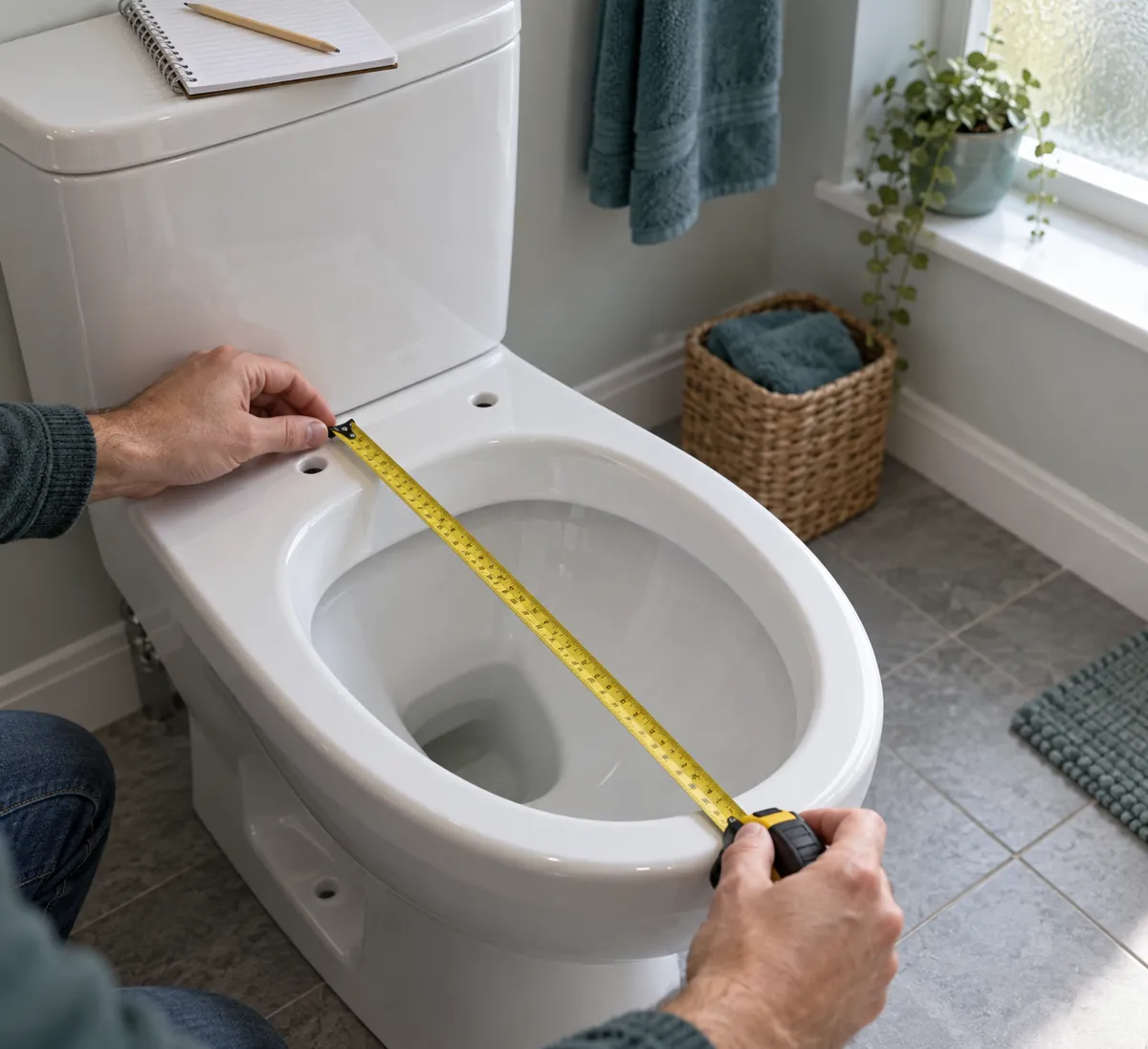
- Take the seat off. Most seats come off with two nuts or quick-release fixings. This gives you the bare pan, which is what you're measuring.
- Measure the bare pan. Write down the spacing between the two fixing holes, the length from the hole line to the front of the rim, the width of the bowl at its widest, and the space behind the holes up to the cistern or wall (that's where a seat's control unit sits). Note whether the rim looks round or elongated.
- Photograph it properly. One photo straight down from above with the tape across the holes, one from the side showing the cistern and the gap behind the holes.
- Decide about the wall. Ask yourself, or your builder, whether the wall behind the toilet will be opened up in any planned work. An installer can assess whether an existing frame, new boxing-in or a seat is practical.
- Send it all off. Email the measurements and photos to a specialist retailer for any seat you're considering. Ask them to confirm fit in writing, and to confirm in writing whether the product has backflow protection built in or needs extra protection in the plumbing.
- Get two quotes. Book a registered electrician to quote for a fixed connection, and a plumber to quote for the water connection, using the product's installation documentation.
Once you've done that, you know which product type suits your room, whether a given seat fits, what the extra work costs, and what the plumbing needs. That answers four of the five questions from the top of this page before you've spent anything.
The installation guides go into what each tradesperson will need from you.
Features worth paying for, and the ones that disappoint
With the room sorted, features are where your money can go furthest. From the manufacturer documents, these are the things that make the most difference in daily use:
- Adjustable temperature, pressure and nozzle position. Different people in the same house want different settings.
- Continuous heating (sometimes called instant or tankless). Tank-heated seats have a limited warm-water capacity; check the model documentation. If several people use the toilet one after another in the morning, this matters more than almost anything else on the spec sheet.
- A removable or replaceable self-cleaning nozzle. You'll be glad of it in year two.
- A heated seat with an eco or timer mode, so it isn't keeping a seat warm all night for nobody.
- A remote or control panel you can read without your glasses, especially if older family members will use it.
Check the warm-air dryer before paying extra for it. Performance varies by model and user, so try a demonstration if drying is important to you. That doesn't make a dryer worthless. It just shouldn't be the reason you pay a few hundred pounds more.
The features hub goes through each of these in more depth.
Choose the brand you can get repaired
Here's the fourth question from the start: who fixes it in the UK. This is where I'd let the decision be made, once you have two or three products that fit your room.
A Japanese toilet is an appliance bolted to your plumbing. At some point a nozzle, a filter, a remote or a circuit board will need replacing. What happens then varies a lot by brand, and it's rarely on the product page.
Look at the published warranties in the table above. They range from a 1-year limited warranty to 3 years, and some brands publish separate cover for parts. Geberit, for example, states 10-year spare parts availability for the Alba and Tuma Comfort. GROHE splits cover between 2 years on the electronic seat and 10 years on bowl parts.
Before you buy, ask the seller or manufacturer these questions, and keep the answers:
- How long is the electronics warranty, and does it include labour or just parts?
- Do I need to register the product, or have it professionally installed, to keep the warranty?
- Is there a UK contact, and do repairs mean an engineer visit or posting the unit back?
- Can I buy spare filters, nozzles and remotes in the UK, and for how long?
- What is the exact UK model number, and is it the 230 V version with the right connection type for a UK installation?
That last one matters more than it seems. The same product name can cover several regional versions. The UK model number is the one that tells your electrician what they're connecting and tells the manufacturer what they're supporting.
Use the warranty and support checklist before ordering; dedicated ownership guides are not available yet.
When a Japanese toilet is the wrong call
Sometimes your survey will give you a no, and it's better to hear it now than after fitting.
Your pan doesn't fit any seat you like, and you aren't refitting. If the retailer can't confirm fit in writing, don't buy on hope. Wait until you replace the toilet, or look at whether a non-electric attachment suits your pan as a stopgap.
Power can't reasonably be got to the toilet. If the electrician's quote is high because of where your circuits run, that's a real cost of the project. Weigh it honestly, or plan the power for when the bathroom is next refitted.
Your water pressure is below the product's range. A weak wash on an expensive seat will annoy you every day. Ask your plumber what's possible before you commit.
You want wall-hung, but the bathroom is finished. You can do it, but you're paying for a mini renovation: frame, boxing-in, tiling, plumbing and power. Price that whole job, not just the toilet.
You rent. Fixed power and changes to the water supply need your landlord's agreement. Get it in writing first.
It's for someone with mobility needs. A shower toilet can make everyday cleanliness and independence easier for some people. The right product, seat height and controls depend on the person, so get an occupational therapist assessment before choosing.
Water Regs UK says bidet showers or douches adjacent to toilets are notifiable in Scotland and Northern Ireland and could be notifiable in England and Wales. Approved-contractor exceptions may apply. Ask your water supplier or an approved contractor about your exact product and installation before work starts.
The pre-purchase buying checklist turns these decisions into measurements and questions for the seller, and you can read how the site researches products on the about page.
Common questions
Do I need a socket next to the toilet for a Japanese toilet seat?
You need a suitable mains connection beside the toilet, assessed by an electrician against bathroom wiring rules. The usual answer is a fixed connection such as a fused spur, fitted by a registered electrician. Never run an extension lead into a bathroom.
Should I buy a bidet seat or a full Japanese toilet?
Consider pan fit, water, power and the building work required. If the bathroom is being stripped and the wall behind the toilet will be open, a wall-hung shower toilet with a concealed frame is realistic. If you are keeping your current toilet and finished walls, an electric bidet seat is usually the sensible choice, provided it fits your pan.
How much does a Japanese toilet cost in the UK all in?
As broad planning figures checked in September 2026, electric bidet seats run from about £250 to £2,500 or more, and complete smart toilets from about £800 to £5,000 or more before fitting. Budget separately for the frame, plumbing, tiling and power; the total depends on the existing installation.
Will an electric bidet seat fit my UK toilet?
Possibly, but check rather than trust 'fits most UK toilets'. Round UK pans are often shorter than the elongated pans many seats are designed for. Measure the bare pan with the seat off, photograph it from above and the side, and get fit confirmation in writing from the retailer before you order.
Is it legal to fit a bidet seat in the UK?
Yes, but the water connection has rules. A washing spray beside a toilet counts as fluid category 5 under UK water regulations, so backflow protection is required. Some products have it built in; others need extra plumbing. Ask your water supplier or an approved contractor whether notification is required for your installation; requirements and exceptions vary by location.