This guide uses AI-assisted desk research and drafting, not hands-on testing or professional installation advice. Read our editorial standards or send a correction.
You start searching for "a bidet" and within five minutes you've seen shower toilets, WASHLETs, smart toilets, bidet seats, bidet attachments, enhancement seats, douche kits and Japanese toilets.
Some of those are the same thing under different names. Some are completely different things that happen to share a name. And the price range runs from about £30 to well over £4,000.
Here's the shortcut that cuts through all of it. Stop sorting by name, and sort by where the water comes out and how it gets there. That's what decides the cost, the building work and, surprisingly often, whether the installation is even allowed.
Quick answer: A bidet is a separate basin. A bidet seat (TOTO calls its own a WASHLET) replaces the seat on your toilet. A shower toilet or smart toilet has the wash built in. A douche is a handheld sprayer on a hose. A bidet attachment is a non-electric nozzle fitted under your existing seat. Anything that sprays upwards or uses a hose near the bowl falls under the strictest UK backflow rules.
Questions you're probably asking, which I'll answer as we go:
- Is a WASHLET just a posh bidet seat?
- What do shops mean by "Japanese toilet"?
- Why would anyone fit an old-fashioned bidet now?
- Which option involves the least building work?
- Which one is easiest to get past UK water rules?
Names describe brands and marketing, not plumbing
A lot of the confusion comes from brand names that drifted into everyday use.
WASHLET is a TOTO trademark. TOTO uses it for its range of electronic bidet seats, and you'll see it used loosely for any similar seat. Other brands can't call their products WASHLETs, so they say bidet seat, bidet toilet seat or shower toilet seat instead.
"Shower toilet" is the term Geberit uses for its AquaClean range. "Smart toilet" is a retailer favourite that can mean almost anything with electronics. "Japanese toilet" is an informal label for the style, and it can point to a seat, a complete toilet or a full shower toilet.
So the first question at the top has a simple answer. A WASHLET is a bidet seat made by TOTO. Every WASHLET is a bidet seat. Not every bidet seat is a WASHLET.
The trouble is that none of these names tells you what you're actually buying into in terms of plumbing. For that, you need a different set of boxes.
Six types, sorted by how the water reaches you
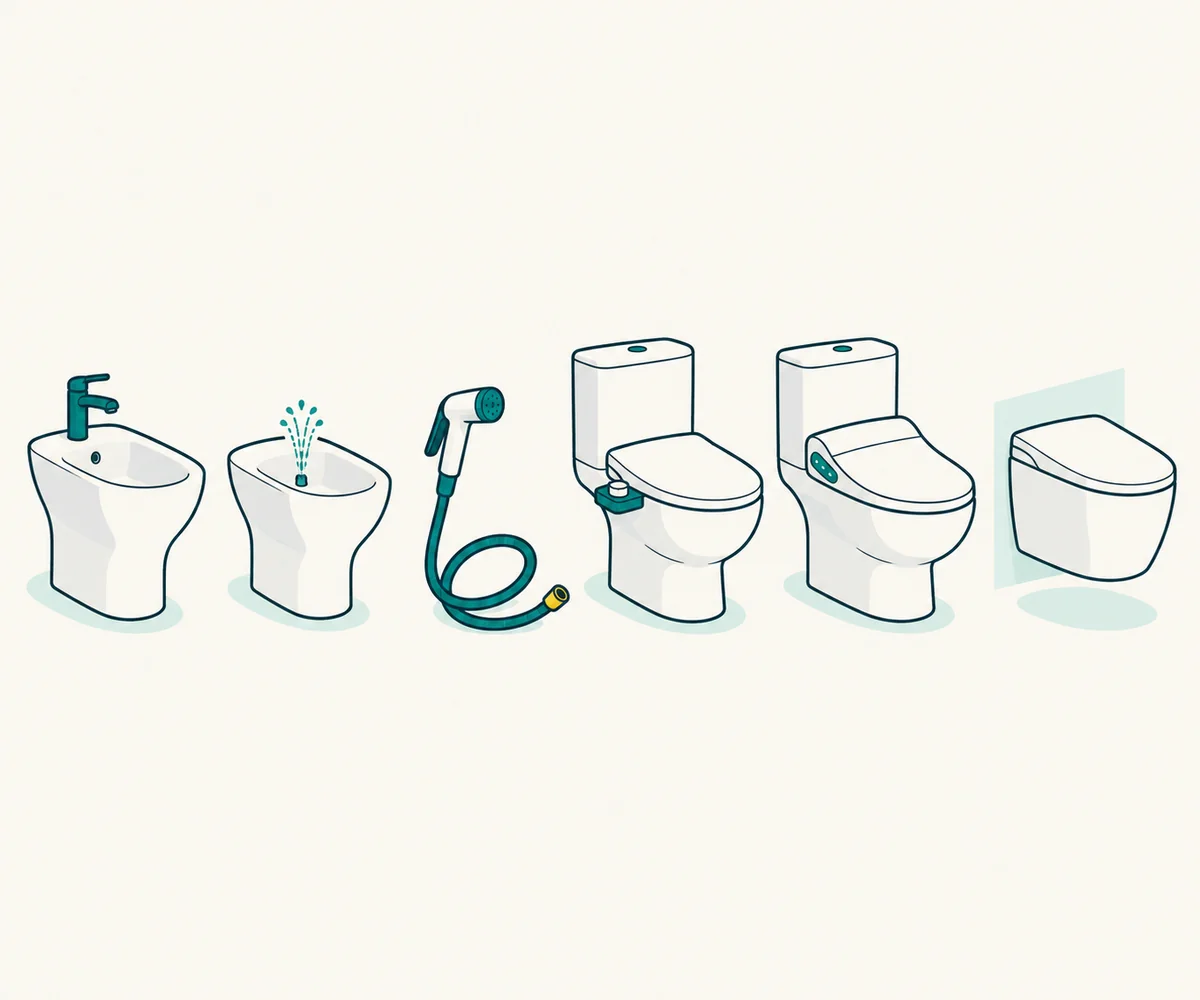
Here's the sorting I'd use. It groups things by what matters in a real UK bathroom.
| Type | Where the water comes out | Power needed | Typical building work |
|---|---|---|---|
| Traditional over-rim bidet | Taps above the rim of a separate basin | No | New basin, waste and supplies beside the toilet |
| Bidet with ascending spray | A jet rising from inside a separate basin | No | As above, plus stricter backflow protection |
| Handheld douche (shattaf) | A spray handset on a hose by the toilet | No | Water supply and valve by the toilet |
| Non-electric bidet attachment | A nozzle fitted between your seat and pan | No | Tap into the toilet's cold feed |
| Electric bidet seat (including WASHLETs) | A retracting nozzle in a replacement seat | Yes | Power and water at the toilet |
| Shower toilet or smart toilet | A nozzle built into a complete toilet | Yes | Often a new toilet, frame, power and water |
Look down the "Typical building work" column and you can already answer one of the opening questions. The least building work usually comes with a non-electric attachment or an electric seat on your existing toilet, because you're not adding a new fixture. But "least building work" and "easiest under the rules" are not the same answer.
The surprise: the old-fashioned bidet is the regulator's friend
Here's what I didn't expect when I read the UK guidance.
UK water fittings rules are there to stop dirty water flowing backwards into the drinking supply. They rate each fitting by how risky the water near it could be. Category 5 is the most serious level, used where water could carry harmful germs.
The Water Regulations Approval Scheme's guidance on bidets, IRN R070, splits bidets by design:
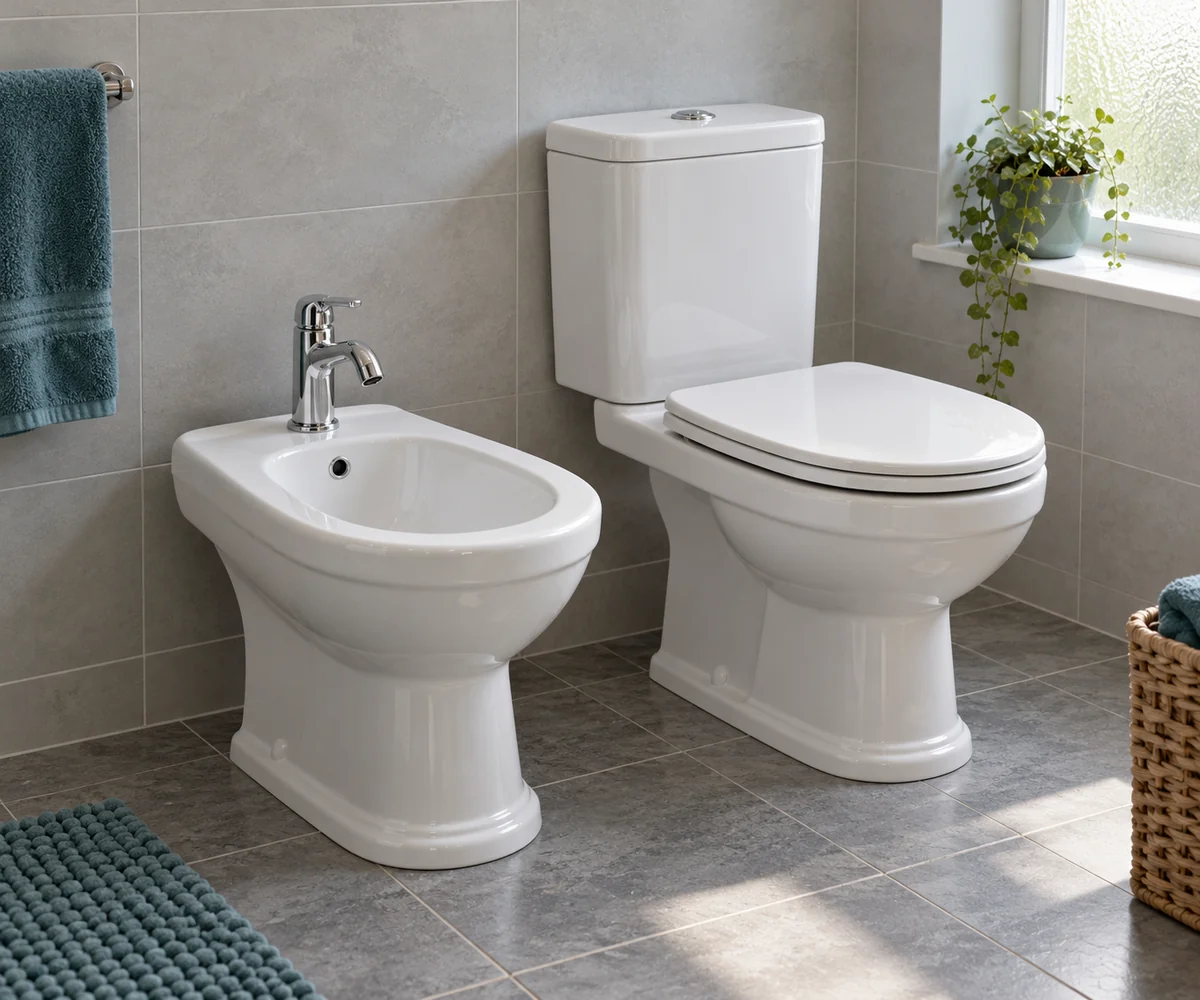
- A domestic over-rim bidet with no ascending spray or flexible hose can be fed from taps, as long as there's a Type AUK2 air gap between the tap outlet and the bidet's spill-over level. In plain terms: the tap sits far enough above the water that dirty water can't reach it.
- Bidets with submerged inlets, a flexible hose, or a spray or jet handset, which WRAS says includes WCs adapted as bidets, are treated as a "fluid category 5 risk". They must not be fed straight from a supply pipe, and they need much stronger protection.
Water Regs UK adds a useful caveat. It says bidets are typically treated as category 5, but some designs may be categorised lower where the risk is lower, such as bidets supplied by taps above the spill-over level in typical homes. It also says that ultimately it's for the local water supplier to decide what protection is needed.
So the plain over-rim bidet, the one many of us think of as old-fashioned, is the design the rules treat most gently. Water comes from above, through an air gap.
Everything else on the list, from the cheap attachment to the £4,000 shower toilet, puts water close to the toilet bowl, from below or on a hose. That's why they fall into the strictest category.
That answers the third question. People still fit traditional bidets because, if you have the floor space, they're simple to plumb compliantly.
What category 5 actually means for each type
Being category 5 doesn't mean a product is banned. It means the installation needs proper protection. Here's what that looks like for each type.
Handheld douche. The hose and handset can reach the bowl, which is why it sits in category 5. Water Regs UK says both cold and, where appropriate, hot supplies need suitable category 5 protection, and gives "a break tank arrangement incorporating a Type AB air gap" as an example. That's a real plumbing job, not a quick kit fit.
Non-electric attachment. It usually takes water from the toilet's cold feed through a T-piece and sends it to a nozzle in the bowl. If the product doesn't state how it provides category 5 protection, assume it needs extra work. I've written more about this in our guide to non-electric attachments versus electric seats.
Electric bidet seat. Some have the protection built in. The plumbers' association APHC warns that "Not all smart toilets or bidet seats on the market are compliant", so check each model rather than assuming.
Shower toilet or smart toilet. Same as electric seats. For example, Geberit's specification plate for the AquaClean Sela lists "EN 13077 / Typ AB", which is the European standard for a Type AB air gap. Look for stated category 5 protection in the documentation, and ask the installer to confirm it.
APHC also says that check valves on their own "don't provide the required level of protection" for this type of appliance. If a seller tells you a non-return valve is all you need, that's a reason to ask more questions.
Does any of this need notifying?
Water Regs UK says installing a bidet shower or douche "is notifiable in Scotland and Northern Ireland and could be notifiable, for example as material change of use, in England and Wales". It also says installing a bidet with a hose handset or ascending spray is notifiable.
I can't tell you whether your particular installation needs notifying. Your water supplier or an approved plumber can. Ask before the work starts, not after.
Which type suits which bathroom?
Now that you can see the types for what they are, the choice gets much easier.
You have space for an extra fixture, and you're refitting. A traditional over-rim bidet is worth considering. It needs no power, and the rules treat it most gently. The catch is floor space, a second waste connection and the fact that you have to move from the toilet to the bidet.
You want to keep your toilet and avoid electrics. A non-electric attachment or a handheld douche. Both are cheap to buy. Both need the backflow question answered properly, and both usually give cold water only.
You want warm water and a heated seat, without replacing the toilet. An electric bidet seat, if one fits your pan. You'll need a fixed power supply beside the toilet. Our best bidet seats guide covers which seats suit UK pans.
You're refitting and want the tidiest result. A shower toilet or smart toilet, often wall-hung on a concealed frame, with the water and power hidden in the wall. Our Geberit AquaClean guide and TOTO WASHLET guide walk through two of the main UK ranges.
Warm water: which types can give it, and what it takes
This is where the types really part company, and it's the thing people are most often disappointed by.
Traditional bidet. It has taps, like a basin. If you run hot and cold supplies to it, you get warm water the same way you do at the sink. The plumbing is ordinary, which is part of its appeal.
Handheld douche. Many kits come with a mixing valve so you can blend hot and cold. That means a hot supply has to reach the toilet, and Water Regs UK says hot supplies to a bidet shower need category 5 protection too. So warm water needs protection for both supplies, not just the pipe run.
Non-electric attachment. Usually cold only. Some offer a hot connection, but that needs a hot pipe at the toilet, which most UK bathrooms don't have in the right place.
Electric bidet seat and shower toilet. These heat the water themselves, from the cold feed. No hot pipe needed. This is the main thing the electricity buys you, along with, on some models, a heated seat and a dryer.
So if warm water is the point, the realistic choices are a traditional bidet with hot and cold taps, or something electric. The cheap routes are cold.
Space: the hidden cost of a separate bidet
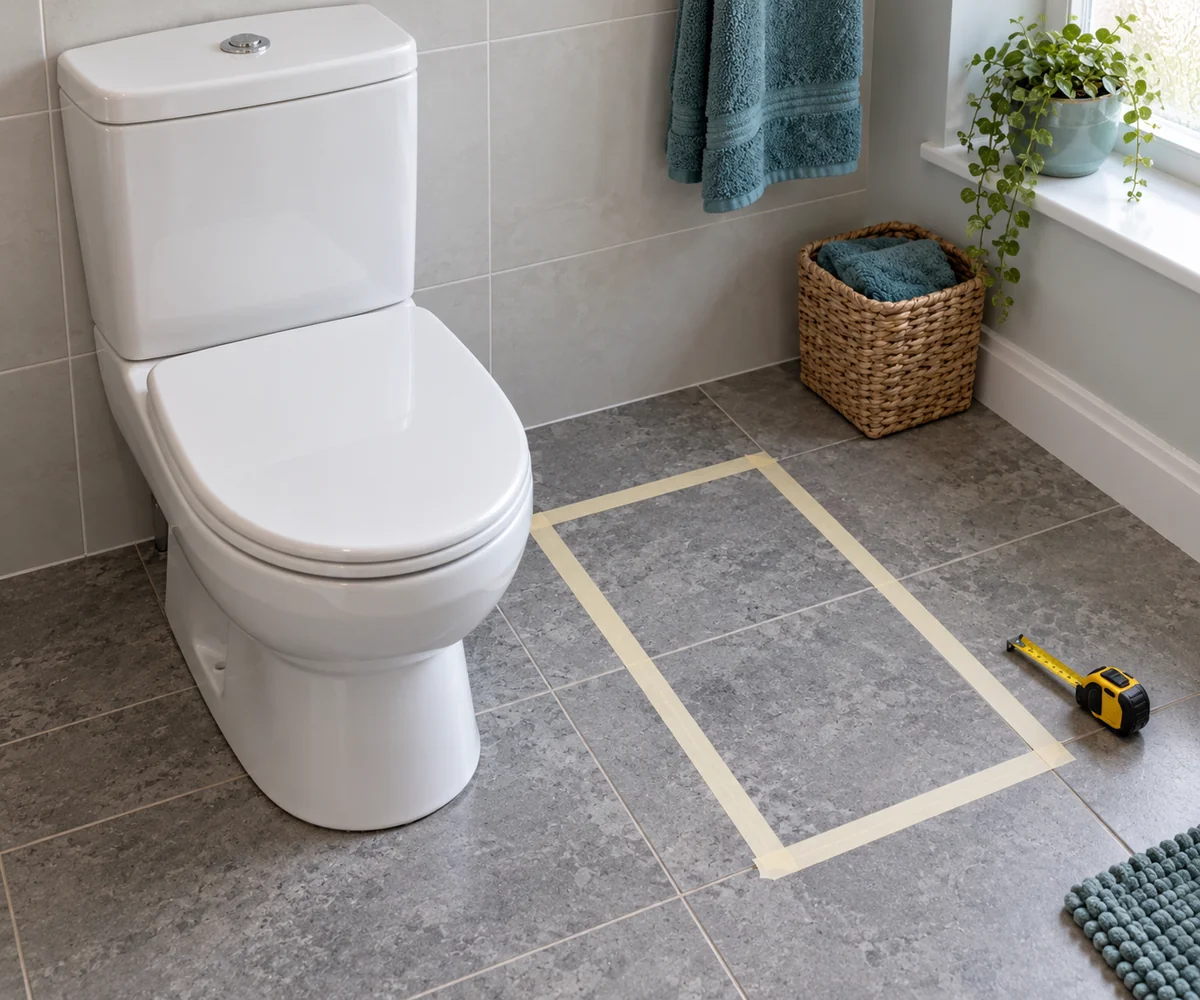
A traditional bidet is simple to plumb, but it's a second fixture, and that's the catch in most UK bathrooms.
It needs its own floor or wall space beside the toilet, enough clear room in front for you to sit astride it, a waste connection, and a route for the supply pipes. In a small bathroom, that space often simply isn't there.
Don't guess. Before you fall for a separate bidet:
- Get the manufacturer's dimension drawing for the exact model, including the recommended clear space in front.
- Mark its footprint on the floor with masking tape, next to the toilet.
- Stand where you'd stand to use it, and check the door still opens and nobody has to squeeze past.
- Ask your plumber where the waste would run.
If the tape outline makes the room feel cramped, a seat or shower toilet does the same job in the toilet's existing footprint.
Read a product listing in two minutes
When you land on any listing, whatever it's called, answer these five questions from the page. If you can't, ask the seller.
- Is it a seat, a complete toilet, a separate bidet, a handset or an attachment? Ignore the product name. Look at the photos and what's in the box.
- Does it need power? If yes, what connection does it expect?
- Where does the water come from? Your toilet's cold feed, a separate supply, or hot and cold?
- How does it meet fluid category 5 protection, or, for an over-rim bidet, what air gap does the tap provide? Look for "Type AB", "EN 13077", "WRAS" or similar in the documentation.
- What does it fit? A specific pan, a range of pan sizes, or any toilet? Check the measurements, not the slogan.
Write the answers next to the price. A £300 product that needs £400 of plumbing to be compliant isn't cheaper than a £600 one with the protection built in.
Mistakes the names lead people into
- Comparing a seat's price with a complete toilet's price. Both get called "Japanese toilets" in listings. One replaces your seat; the other replaces your toilet.
- Assuming "bidet" means a separate basin. In many listings it means a seat or an attachment.
- Treating a douche kit as a five-minute job. The hose puts it in category 5.
- Trusting "fits all toilets". Some do fit most toilets in the market they were designed for. UK pans vary.
- Assuming a big brand means built-in protection. Check the documentation for each model.
So which is it?
Back to the opening questions.
A WASHLET is TOTO's name for its bidet seats. "Japanese toilet" is a loose label that can mean a seat, a smart toilet or a shower toilet, so check which. People still fit traditional over-rim bidets because the rules treat them most gently, if there's room. The least building work usually comes with a seat or attachment on your existing toilet. And the easiest to get past the water rules is often the plain over-rim bidet, or a seat or toilet whose documentation states category 5 protection.
If you've worked out which type you want, our Japanese toilets guide is the best next read. It covers the power, water and fit checks for seats and complete toilets in more depth.
Common questions
What is the difference between a shower toilet and a bidet?
A bidet is a separate basin next to the toilet that you sit on to wash. A shower toilet has a wash function built into the toilet itself, with a nozzle that extends under you. In the UK, Geberit calls its AquaClean range shower toilets. Other brands and retailers use smart toilet, bidet toilet or Japanese toilet for similar products.
Is a WASHLET the same as a bidet seat?
WASHLET is a TOTO brand name for its electronic bidet seats. Other makers sell similar products as bidet seats, shower toilet seats or enhancement seats. So every WASHLET is a bidet seat, but not every bidet seat is a WASHLET.
Which type of bidet is easiest to install under UK water regulations?
Often the traditional over-rim bidet with taps above the rim. WRAS guidance says a domestic over-rim bidet without an ascending spray or hose can be fed through taps with a Type AUK2 air gap. Bidets with an ascending spray, a hose or a spray handset, including WCs adapted as bidets, are treated as fluid category 5 and need stronger protection.
Is a handheld bidet sprayer or douche allowed in the UK?
It can be installed, but the installation has to meet fluid category 5 backflow protection because the hose and handset can reach the toilet bowl. Water Regs UK says installing a bidet shower or douche is notifiable in Scotland and Northern Ireland and could be notifiable in England and Wales. Ask a plumber or your water supplier first.
What is a Japanese toilet?
It's an informal name for a toilet or toilet seat with a built-in wash function, after the style popularised in Japan. In UK shops it can mean an electric bidet seat, a complete smart toilet, or a shower toilet. Check exactly which one a listing is selling before you compare prices.